Frequently Asked Questions about Reclaimed Wood from Brenners Altholz
We ship reclaimed wood worldwide, regardless of quantity. Our high‑quality reclaimed‑wood products reach you in Germany, Austria, Switzerland, and beyond.
Between 30 and around 300 years, depending on the range. Sunburnt boards are often weathered enough after 30 to 40 years, while original hand-hewn timber dates from before the sawmills and is more than 100 years old. How old is reclaimed wood really?
With a fixed-width sorting you receive 4 to 6 uniform board widths, for example 8, 10, 12, 13, 15, 17 cm, so the boards can be installed butt to butt. Which widths these are depends on the available raw material. Mixed widths, fixed widths or cut to size?
We produce to order, and production starts once your payment has been received, so you get exactly the material your project needs. The planned delivery time is stated in your quotation. Why is the delivery time long?
The boards originally came from old stables, farmhouses and barns. Depending on the building’s orientation to the sun or weather side, different hues from light to dark brown developed on the surface over time.
For this reason, we cannot guarantee a specific colour sorting.
Sun and rain break down the lignin in the wood, which creates the typical light to dark grey patina. On a north-facing facade this happens faster, because the wood is exposed to more weather. Why does old wood turn grey?
Round logs used to be squared with a broad axe, and the axe marks remain visible as irregular facets. This was common until around 100 years ago. What is a hand-hewn surface?
With the “kiln‑dried” (KD) process, reclaimed wood is dried in a kiln at over 56°C for several days; this eliminates insect infestation at the time of delivery. It is an environmentally friendly form of pest control.
The Austrian Plant Protection Service in Upper Austria confirms that, under registration number AT-08403, we are listed in the official register and regularly inspected for compliance with ISPM No. 15.
Please understand that any subsequent infestation after this point is outside our control and therefore cannot be ruled out.
We therefore recommend preventive treatment against renewed infestation.
Untrimmed reclaimed boards retain their natural live edges, giving them a rustic and authentic appearance—ideal for projects seeking a historical or natural look.
With tongue and groove, each board has a groove on one edge and a machined tongue on the other, which fits into the groove of the next board. Quantities are calculated on the covering width, so 7 to 12 % extra material is needed. What is tongue and groove in reclaimed wood?
This refers to cutting off the boards’ original margins (live/waney edges). Trimmed sides make installation easier.
The surface of the reclaimed wood is worked with a rotating brushing head.
Softer wood fibres are removed from the surface; the harder fibres remain and define a textured surface.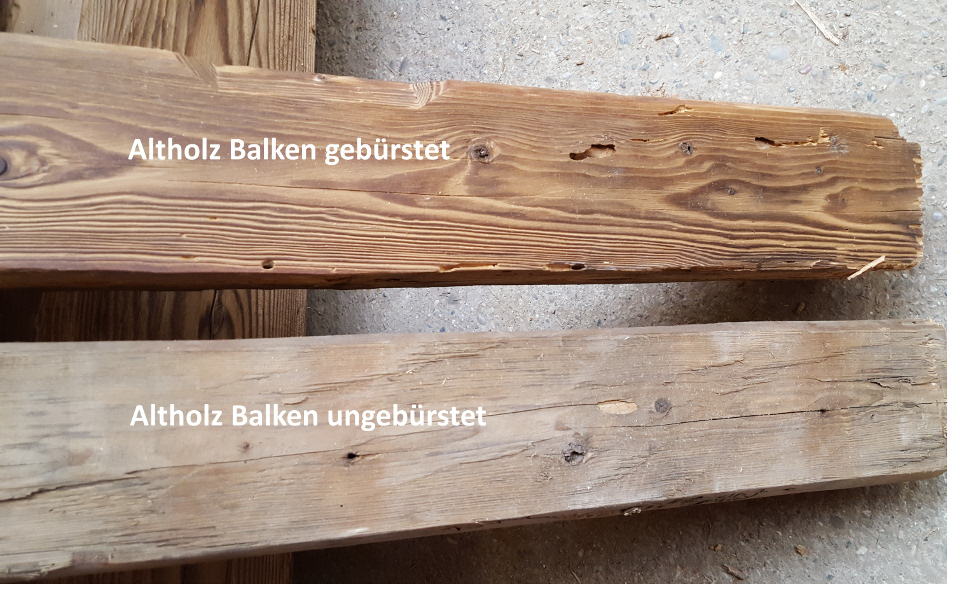
The surface of the reclaimed wood is worked with a sanding machine.
This evens out the wood’s irregular structure and creates the perfect surface for e.g. dining tables and worktops.
We describe wood as “saw‑rough” when the original surface has been sawn off.
This is mainly done on one side of the reclaimed wood (e.g. sawn top/bottom of beams). You can recognise a saw‑rough surface by its lighter tone.
Reclaimed‑wood beams were originally installed in agricultural and residential buildings. Mortise holes and notches were used to join beams without metal. Beams without notches are rarer and must be selected with care. Therefore the option “without mortise holes and notches” comes with a surcharge.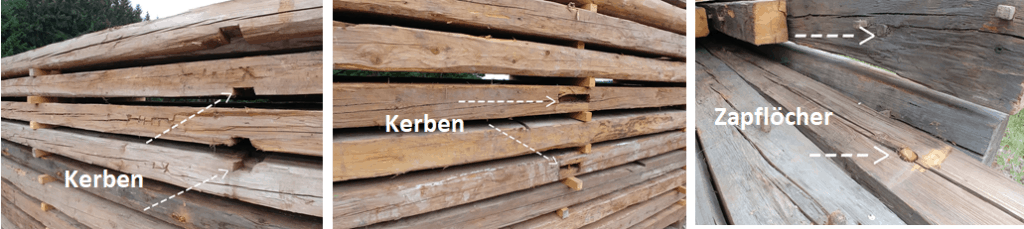
More on notches and mortise holes here.
Solid beams in spruce and oak in four sortings, with cross-sections from 10x12 to 24x28 cm and lengths from 100 cm to over 10 m, plus the hollow NextBeams profiles. Which reclaimed beams are available?
Measure the wall or room/floor to be clad.
For example, the wall is 3 m wide (a) and 2 m high (b). Multiply 3 m (a) × 2 m (b) = 6 m²
Keep in mind that around 10% off‑cut (≈0.6 m²) is usually needed = total 6.6 m²

Here is a little more information.
The boards are screwed onto a vertical batten frame: battens 20 × 40 mm spaced 60 to 80 cm apart, with the boards fixed at an angle through the edge and roughly 10 mm clearance from the floor. This applies to tongue-and-groove and to plain-edged boards alike. Full guide with drawings
A BoxedBeam® is slid over a batten fixed to the ceiling or wall and screwed into that batten from both sides. The batten is slightly narrower than the inside of the U-profile; its height does not matter. Existing wooden beams and steel joists are clad the same way.
You can find the full guide with drawings here.
Tapered means that a beam is slightly narrower at one end than at the other, for example from 14x16 to 12x14 cm. The reason is the natural taper of the trunk. What is a tapered beam?
Our reclaimed wood is purely natural and is not additionally treated.
The surface colour does not change indoors. Only with direct and continuous sunlight may the wood darken slightly. Reclaimed wood does not need to be oiled or otherwise further worked.
Yes. Outdoors reclaimed wood behaves like new wood and belongs on a batten frame with rear ventilation so it can dry after rain. Direct contact with soil should be avoided. Reclaimed wood as a facade
Old wood can—and is—used in wet rooms such as bathrooms.
It requires a batten substructure that provides rear ventilation for the wall cladding.
Old wood absorbs moisture and releases it later, which also promotes a pleasant indoor climate.
Only direct contact with water over a prolonged period should be avoided.
Occasional splashing water is absolutely no problem with rear ventilation.
If you, as an entrepreneur, do business with companies in other EU countries, you need to use the so‑called “VAT identification number” (VAT ID). Each VAT ID consists of a two‑letter country code and two to twelve further characters, which may include letters depending on the EU state (e.g. Ireland, Netherlands, Spain).
The Austrian VAT ID always begins with the country code AT, contains a “U” in the first position and then eight digits (e.g. ATU12345678). See also: https://www.bmf.gv.at/themen/steuern/fuer-unternehmen/umsatzsteuer.html
Of course, consumers/private individuals can also buy Brenners Altholz products.

