

What Are “Mortise Holes and Notches”?
In short – reclaimed beams were originally used in farm and residential buildings. Using mortise holes and notches, the beams were connected without metal fasteners.
Beams without notches are rarer and must be carefully selected. Therefore, the variant “without mortise holes and notches” comes with a certain surcharge.
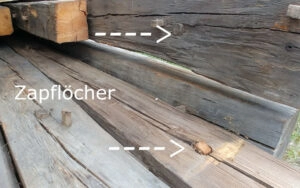
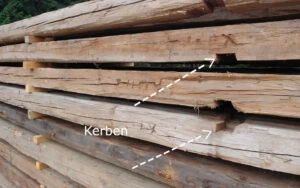
Mortise holes are openings cut or drilled into a wooden beam to receive a tenon (a projecting part of another beam). The tenon is inserted into the mortise hole and wedged to create a solid joint. This technique is commonly used in traditional timber-frame or half-timbered construction and is also known as mortise-and-tenon joinery.
Notches are indentations or cut-outs made in beams to connect them with another beam or structural component. Notches can appear in various shapes and sizes, depending on their intended use. An example of a notch connection is the so-called “lap joint,” where two beams are beveled at the ends and interlocked to form a stable joint.
Since reclaimed beams with mortise holes and notches are signs of historical craftsmanship and traditional building methods, they are often valued by architects, designers, and builders who want to incorporate the rustic character and patina of these materials in their projects. However, beams without notches are rarer and require careful selection, as they usually come from unused or less-stressed parts of reclaimed buildings. For this reason, reclaimed beams without mortise holes and notches can be more expensive than those with these features.